If your daily workflow involves jumping between Chrome tabs, Notion pages, Slack messages, AI tools, and endless copy-paste tasks, you’re probably already looking for a better system.
That’s where Runable enters the conversation.
Unlike traditional AI chatbots that only generate text, Runable positions itself as a full AI execution agent — software that can actually perform tasks, automate workflows, connect apps, and produce finished outputs with minimal human involvement.
After researching the platform, testing features, and comparing it with tools like Zapier, Make, and AI copilots, here’s my complete Runable AI review for 2026.
What Is Runable AI?
Runable is an AI-powered automation platform designed to execute multi-step digital tasks from a single prompt.
Instead of asking AI for ideas or drafts, you tell Runable the final outcome you want, and the platform attempts to handle the entire workflow automatically.
Examples include:
- Building presentations
- Creating reports
- Generating websites
- Producing AI images and videos
- Running browser tasks
- Automating repetitive workflows
- Connecting external apps and services
- Scheduling recurring automations
The core concept is simple:
Traditional AI chats with you.
Runable tries to work for you.
The platform describes itself as an “AI agent” rather than a chatbot because it focuses on execution instead of conversation.

How Runable Works
The workflow inside Runable is surprisingly straightforward.
You start by describing a task in natural language, such as:
- “Create a weekly SEO report from my analytics data.”
- “Generate a product presentation for investors.”
- “Build a landing page for my SaaS.”
- “Research competitors and summarize the findings.”
Runable then breaks the request into multiple steps internally.
Depending on the task, it may:
- gather information,
- generate content,
- create assets,
- connect with external tools,
- and package everything into a finished result.
One interesting feature is the ability to save workflows as reusable “Runbooks,” allowing repeated automations without rebuilding the process every time.
The Biggest Difference Between Runable and ChatGPT
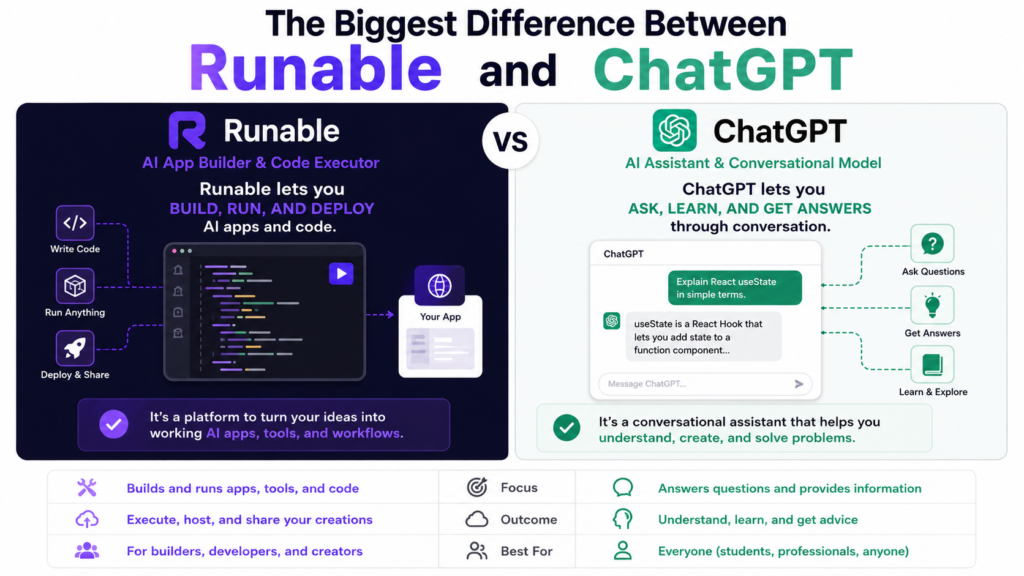
A lot of people confuse AI agents with AI chatbots, but they’re not the same thing.
ChatGPT is excellent for:
- brainstorming,
- writing,
- coding assistance,
- answering questions.
But most chatbots stop after generating text.
Runable attempts to continue beyond the response stage by actually taking actions.
For example:
- opening tools,
- connecting apps,
- generating deliverables,
- scheduling workflows,
- or automating browser-based processes.
That makes it closer to:
- Zapier,
- Make,
- UiPath,
- or AI-powered RPA systems,
rather than a simple conversational assistant.
The idea is not just “AI that talks,” but “AI that executes.”
Key Features of Runable AI
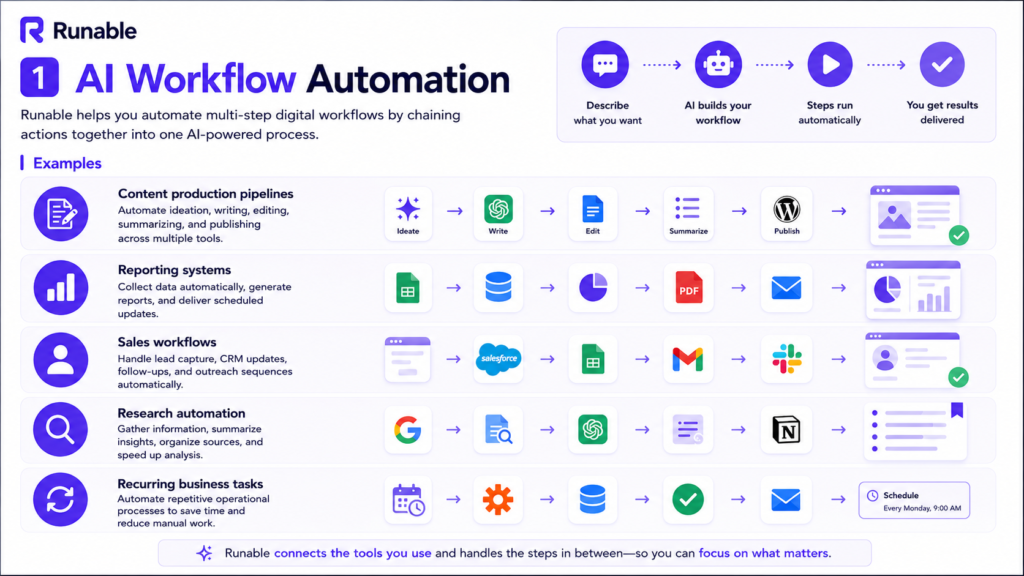
1. AI Workflow Automation
This is the platform’s core strength.
Runable can chain together multiple actions into a single automated process. Instead of manually moving between apps, the AI handles the transitions for you.
Examples:
2. Multi-Format Content Generation
Runable supports several output types inside one ecosystem:
- presentations,
- reports,
- websites,
- podcasts,
- images,
- videos,
- documents.
That makes it more versatile than many single-purpose AI tools.
3. Large Integration Ecosystem
Runable claims integrations with thousands of external tools and services.
This matters because AI automation becomes significantly more useful when connected to:
- CRMs,
- Google Workspace,
- Slack,
- analytics tools,
- marketing platforms,
- databases,
- productivity apps.
According to public platform information, Runable supports more than 2,500–3,000 integrations.
4. Reusable Runbooks
One underrated feature is workflow memory.
After completing a task successfully, you can save the process as a reusable automation template.
This turns one-time AI assistance into repeatable operational systems.
For agencies, marketers, and teams, this could become a major productivity advantage.
5. Human-in-the-Loop Editing
Unlike fully rigid automations, Runable allows users to intervene, provide feedback, and refine tasks during execution.
That flexibility is important because AI agents still make mistakes, especially with complex workflows.
Runable Pricing (2026)
At the time of writing, Runable offers multiple pricing tiers.
Current public pricing includes:
| Plan | Price |
| Starter | Around $25/month |
| Pro | Around $50/month |
| Unlimited | Around $200/month |
The platform also includes usage-based credit systems depending on the plan.
Pricing may change over time, so always verify directly on the official website before purchasing.
Who Should Use Runable?
Runable makes the most sense for users who repeat digital workflows frequently.
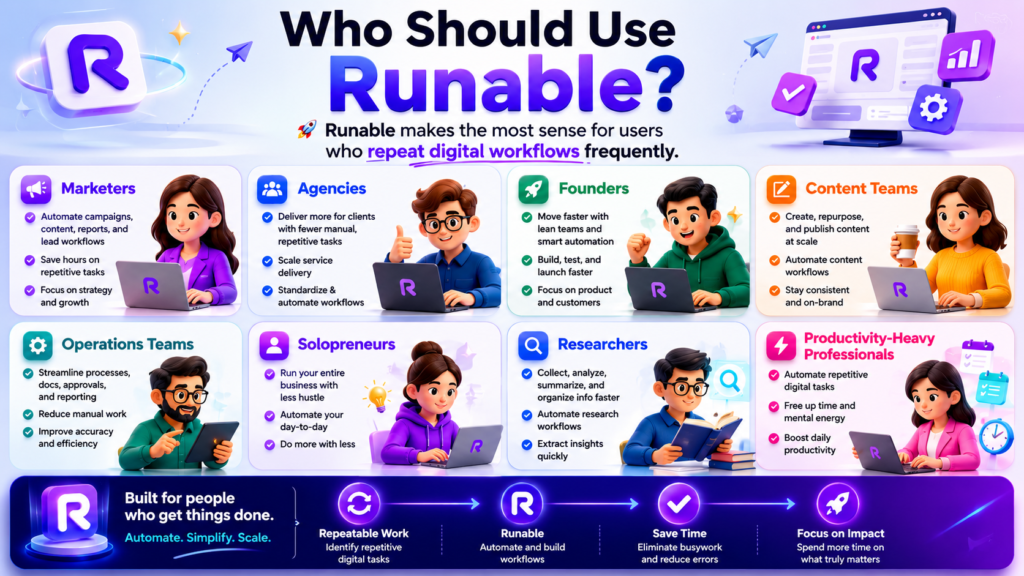
It is especially useful for people already combining:
- ChatGPT,
- automation tools,
- AI design platforms,
- spreadsheets,
- workflow software,
- browser tasks.
If your workflow already involves many disconnected tools, Runable may help consolidate some of that complexity.
Where Runable Still Has Limitations
Even though AI agents are improving quickly, they’re not perfect.
Current limitations include:
- occasional workflow failures,
- inconsistent outputs,
- dependency on integrations,
- learning curve for advanced automations,
- credit usage costs,
- and unpredictable AI behavior on complicated tasks.
Like most AI agent platforms in 2026, Runable still works best when supervised rather than fully autonomous.
This is not a complete replacement for human operations yet.
Runable vs Zapier and Make
A common question is whether Runable replaces automation tools like Zapier or Make.
The answer is: partially.
Traditional automation platforms rely on rule-based logic:
- trigger → action → condition.
Runable introduces AI reasoning into the process.
Instead of manually building every workflow step, you describe the goal, and the AI attempts to plan the execution dynamically.
That’s a very different experience.
However:
- Zapier and Make are still more stable for mission-critical automations,
- while Runable is more flexible and AI-native.
Think of Runable as:
AI-first automation.
And Zapier/Make as:
rule-based infrastructure automation.
My Final Verdict on Runable AI
Runable represents a bigger shift happening across the AI industry:
AI is moving from “answering questions” toward “completing workflows.”
That transition could become one of the most important software trends over the next few years.
What I like:
- ambitious vision,
- broad automation capabilities,
- modern AI-first approach,
- reusable workflows,
- multi-format output generation.
What still needs improvement:
- reliability,
- execution consistency,
- advanced workflow stability,
- enterprise-grade precision.
Overall, Runable feels more advanced than a typical AI wrapper tool, but it’s still part of an emerging category that’s evolving rapidly.
Why tools like Runable feel like the next phase of AI, and how I’d test it before I trust it
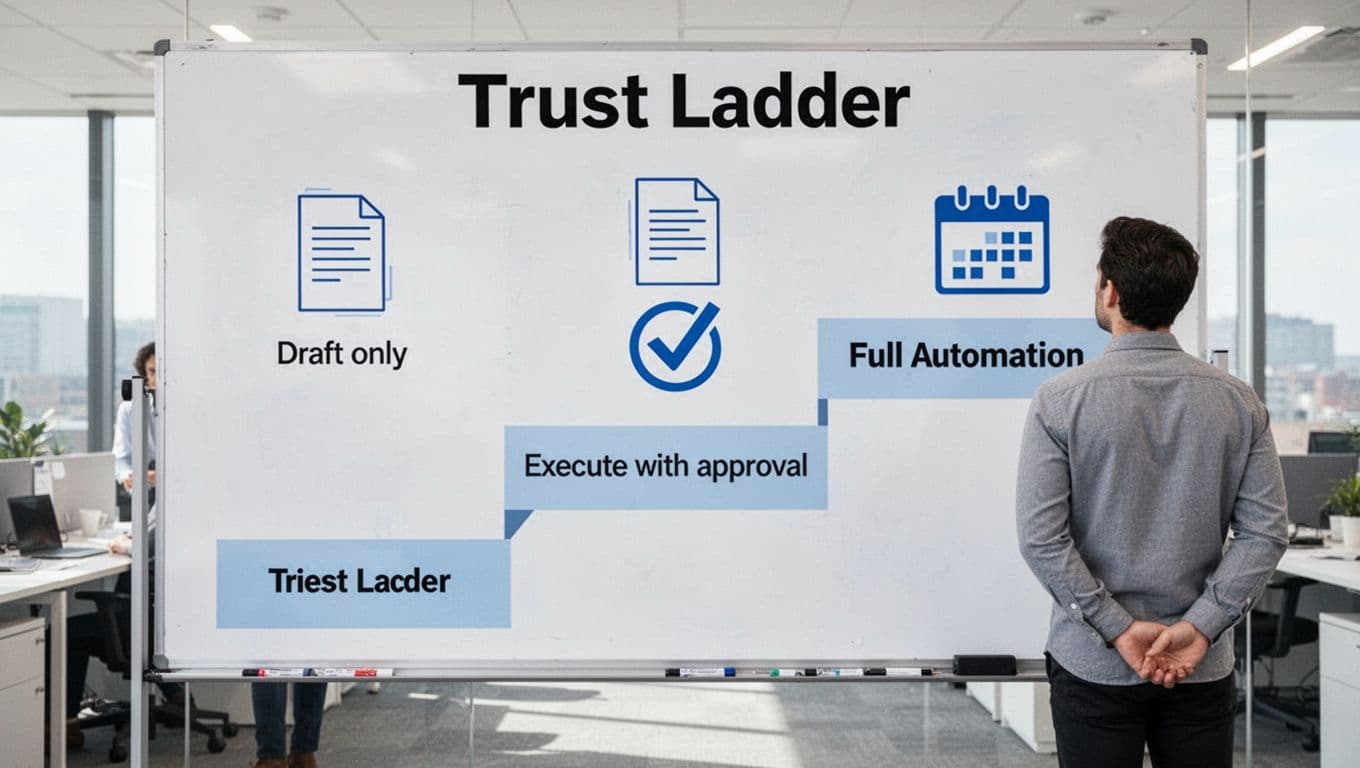
The shift I’m watching in 2026 is simple: AI is moving from single outputs (a paragraph, a summary) to multi-step outcomes (a report sent, a runbook scheduled, a workflow closed).
With Runable, I don’t start by asking “can it do everything?” I start by asking “can it do one thing end-to-end, repeatedly, with logs and approvals?” If the answer is yes, I expand.
Runable’s freemium setup helps here. Based on current public info, the free tier is designed for testing with limited executions (often described as up to about 100 runs per month using your own API key), then Plus and Pro unlock more consistent daily use. If you want a quick pricing snapshot as it’s commonly published right now, Runable’s listing on OpenTools is one place tracking it.
If you enjoy experimenting with AI automation and productivity systems, it’s definitely worth testing.
For now, I’d view Runable as:
- a powerful productivity assistant,
not yet - a complete operational replacement.
Rating: 8.3/10
Frequently Asked Questions
Is Runable free?
Runable offers entry-level plans and occasionally free access tiers, but most advanced features require a paid subscription.
Is Runable an AI chatbot?
Not exactly. Runable functions more like an AI agent that can execute workflows and automate digital tasks rather than only generating text responses.
Can Runable replace Zapier?
For some workflows, partially yes. However, traditional automation platforms are still more stable for highly structured business automations.
Does Runable support integrations?
Yes. Public sources state the platform supports thousands of integrations with external apps and services.
Is Runable good for affiliate marketers?
Potentially yes. Affiliate marketers could use it for:
- content generation,
- reporting,
- research,
- workflow automation,
- social media production,
- and repetitive operational tasks.
👉 Start here (Free Trial): https://runable.com/?via=andrew